TL;DR
- Choose a saddle stool if you lean toward your work, move around a lot, or work at a raised surface such as a dental chair, salon station or standing desk.
- Choose a kneeling chair if you sit still at a normal-height desk and want the strongest support for your lower-back curve.
- Choose a wobble stool if you want to keep moving while you sit and only sit for short stretches.
- A flat or round stool is fine for short tasks but makes it easiest to slump over time.
- None of these has been proven to cure back pain, and the research favors changing position through the day over any one seat.
Last updated October 19, 2026. Based on published sitting-posture research, Amazon specifications and first-hand user reports.
Disclosure: some links on this page are affiliate links. If you buy through them we may earn a small commission at no extra cost to you.
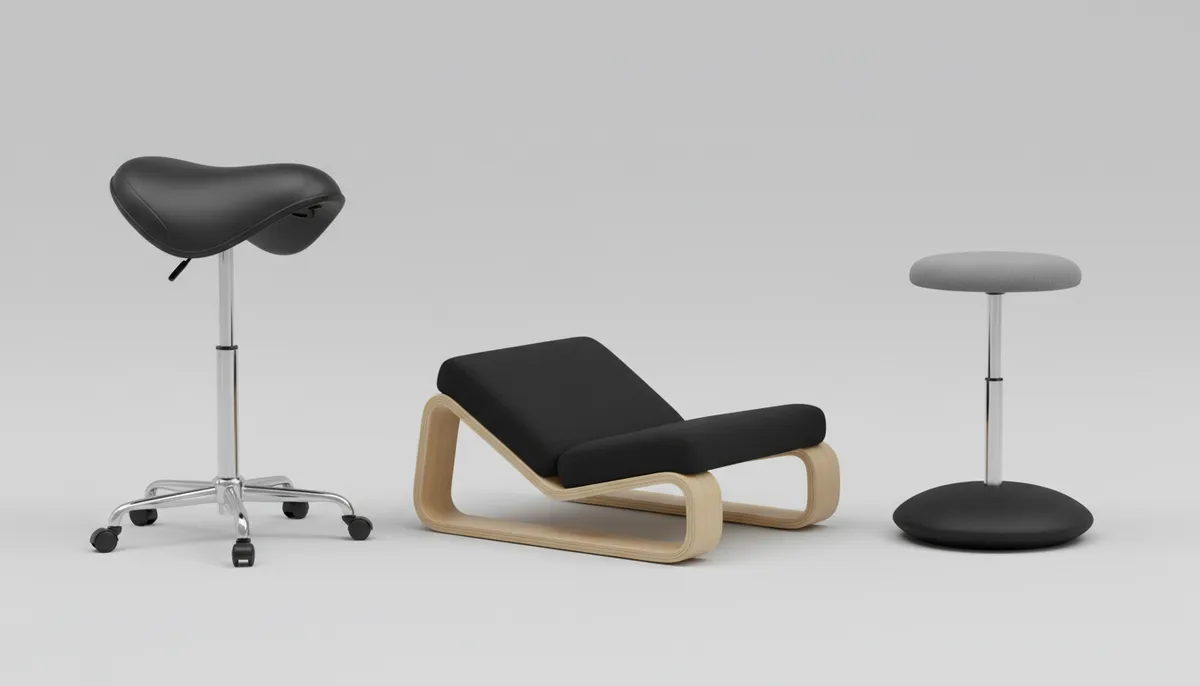
A saddle stool is best for active, forward-leaning work, a kneeling chair is best for still desk work, and a wobble stool is best for short periods of movement-based sitting.
All three open your hip angle beyond the 90 degrees of a normal chair, which tilts your pelvis forward and helps your lower back keep its natural curve.
They differ in how much they let you move, how high they sit, and how long most people can comfortably use them.
This guide compares them side by side, with what the research shows and which one to buy for your situation.
Saddle Stool vs Wobble Stool vs Kneeling Chair vs Flat Stool
| Saddle stool | Kneeling chair | Wobble stool | Flat or round stool | |
|---|---|---|---|---|
| How you sit | Straddling a saddle, thighs angled down | Seat tilted forward, shins resting on knee pads | Upright on a rounded base that tilts in every direction | Upright on a flat seat |
| Hip angle | About 110 to 135 degrees | About 110 to 130 degrees | Varies as you move | About 90 degrees |
| Movement while seated | Rolls freely, easy to reposition | Some models roll on casters, but getting in and out takes practice | Constant small movements, base stays put | Rolls freely |
| Typical height | Mid to tall, suits raised work surfaces | Low, suits standard desks | Adjustable, many reach standing-desk height | Wide range |
| Best for | Dental, salon, tattoo, lab and standing-desk work | Typing and reading at a normal desk | Short sessions, restless sitters, classrooms | Short tasks, people new to active seating |
| Main drawback | One- to two-week adaptation, seat width must fit | Pressure on the knees and shins, hard to move | Tiring to use for long periods | Easiest to slump on |
| Typical weight rating | About 300 to 400 lb | About 250 to 265 lb | About 265 lb | Varies widely |
| Typical price on Amazon | Budget to mid | Budget to mid | Budget to mid | Budget |
What the Research Says
There is no head-to-head study of all four seats, but several smaller studies help.
- Kneeling chairs: a pilot study of 20 people found kneeling chairs kept the lower back’s natural curve better than flat chairs, in both people with chronic low back pain and healthy controls, and a 2025 study found less lower-back muscle activity and discomfort in kneeling positions.
- Saddle chairs: a study on spinal curvature found saddle chairs increased the lower-back curve, which is the intended effect, but also increased forward head and neck protraction, so neck position needs attention.
- Wobble and dynamic stools: evidence is thinner and mixed, with one study finding spinal curves closer to standing on a dynamic stool and a radiographic study finding the lowest lumbar disc height on a stool among the seats tested.
- The big picture: none of these studies measured whether a chair reduces back pain over months, and the consistent finding in workplace research is that changing position matters more than finding one perfect seat.
Saddle Stool: Best for Active, Forward-Leaning Work
A saddle stool lets you sit tall and close to your work while still rolling freely, which is why dentists, hygienists, stylists and tattoo artists use them.
It suits raised work surfaces, because you sit higher than on a normal chair.
The trade-offs are an adaptation period of about one to two weeks and the need for a seat width that suits your pelvis.
If a solid saddle presses on your hips or groin, a split saddle spreads the load, and users with hypermobility on r/Ergonomics reported that a split seat let their hips relax.
- Antlu saddle stool with back support: our most-recommended saddle stool across guides, with a backrest for breaks. Check price on Amazon
- Master Massage split saddle stool with backrest: the pick if solid saddles cause pressure. Check price on Amazon
See our full guides to saddle stools for back pain and saddle stool sizing.
Kneeling Chair: Best for Still Desk Work
A kneeling chair tilts the seat forward and supports part of your weight on your shins, which keeps your lower back curved while you sit at a normal-height desk.
It has the strongest research support of the three for maintaining the lumbar curve.
Some kneeling chairs roll on casters, but getting in and out still takes practice, and some people find the knee pads uncomfortable after an hour.
Interest in kneeling chairs has been falling in Google Trends over the past five years while interest in ergonomic and wobble stools has been rising.
- DRAGONN by VIVO ergonomic kneeling chair: the most-reviewed kneeling chair on Amazon, with more than 5,000 ratings, a 21 to 28 inch height range, casters and a 250 lb rating. Check price on Amazon
- Sleekform Austin kneeling chair: a rocking wooden design that lets you shift your weight while you work, rated for 265 lb and sized for users from 5 ft 2 in to 6 ft 6 in at a standard desk. Check price on Amazon
Wobble Stool: Best for Short Stretches of Active Sitting
A wobble stool has a rounded base that tilts in every direction, so you make constant small balancing movements while you sit.
It is popular for standing desks and classrooms, and for people who struggle to sit still.
Most adults find a wobble stool tiring over a full day, so it works best for short sessions alternating with a regular chair or standing.
- SONGMICS ergonomic wobble stool: an adult wobble stool that adjusts from 23.6 to 33.3 inches, tall enough for standing desks, rated for 264 lb. Check price on Amazon
- Learniture active learning stool: a lower wobble stool that adjusts from 18.5 to 28 inches for regular desks, rated for 265 lb, with more than 2,000 ratings. Check price on Amazon
Flat or Round Stool: Fine for Short Tasks
A flat stool keeps your hips at about 90 degrees, which makes it easy to round your lower back as you lean forward.
It is perfectly fine for short tasks, and it is the easiest seat to start with.
If you sit for long periods, a saddle stool or a kneeling chair is usually a better choice for your posture.
Which One Should You Buy?
- Dental, medical, salon, tattoo or lab work: saddle stool.
- Standing desk: saddle stool or wobble stool set to the right height.
- Typing and reading at a normal desk for hours: kneeling chair, alternating with a standard chair.
- Restless sitters and kids: wobble stool.
- Sore hips or groin on a saddle: split saddle stool.
- Knee problems: avoid a kneeling chair and choose a saddle stool instead.
- Heavier users: saddle stools usually carry higher weight ratings (often 300 to 400 lb) than kneeling chairs and wobble stools (about 250 to 265 lb).
If you are deciding between a saddle stool and a regular office chair, our saddle stool vs office chair comparison covers that choice in detail.
FAQs
What is the difference between a saddle stool and a wobble stool?
A saddle stool has a horse-saddle seat on a rolling base that keeps your thighs angled down, while a wobble stool has a rounded base that tilts in every direction so you keep moving. Saddle stools suit long working sessions at raised surfaces, and wobble stools suit short periods of active sitting.
Is a kneeling chair or a saddle chair better?
A kneeling chair is better for still desk work at a normal desk height, while a saddle chair is better for active work where you lean forward and move around. Both open the hip angle and support the lower-back curve.
Are wobble stools good for your back?
Wobble stools keep you moving, which some people find helps, but the research on them is limited and mixed. Most adults use them for short periods rather than a full workday.
Is a saddle stool better than a regular stool?
For long sitting, usually yes. A saddle stool opens the hip angle to about 110 to 135 degrees, which helps the lower back keep its curve, while a flat stool makes slumping easier. A flat stool is fine for short tasks.
Can you use a kneeling chair all day?
Most people cannot use a kneeling chair comfortably all day because of pressure on the knees and shins. It works best alternated with a regular chair or standing.
Do saddle stools help with posture?
Saddle stools tilt the pelvis forward and help the lower back keep its natural curve, but one study found they can increase forward neck posture, so keep your work at the right height and your head close to upright.