
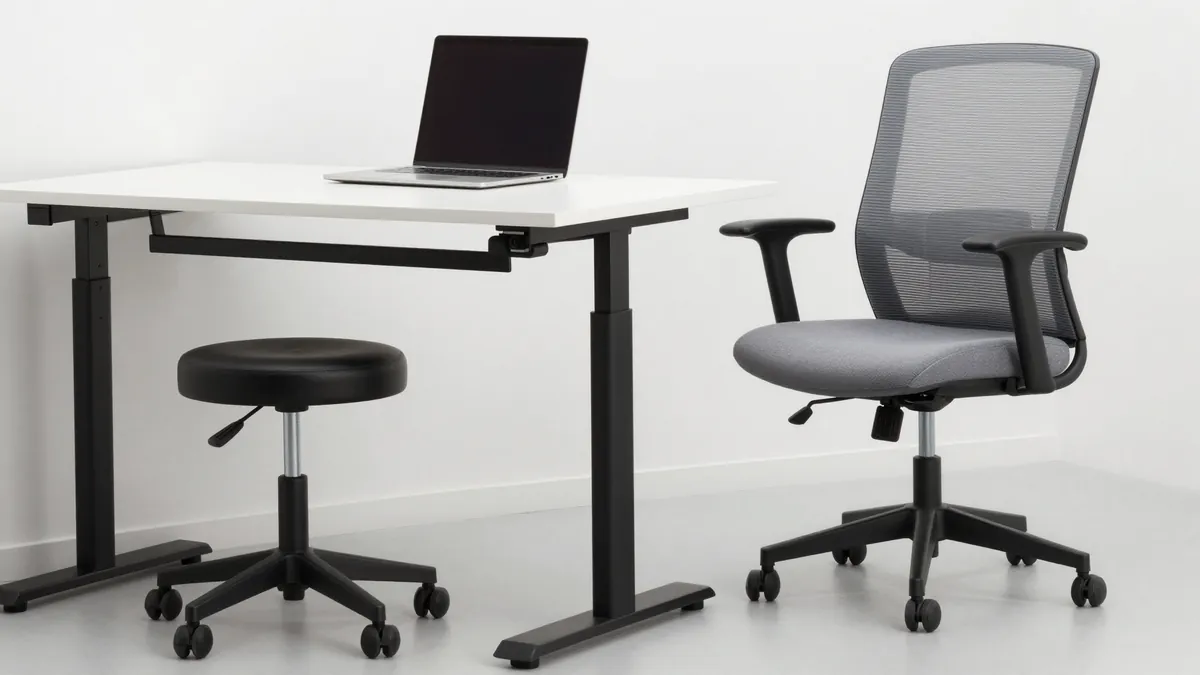
TL;DR
- Choose a saddle stool for active, forward-leaning work and for fixing slump-related back pain.
- Choose an office chair for long relaxed sitting, meetings, and leaning back to think.
- The saddle keeps your lumbar curve automatically; the office chair supports it externally.
- Many people do best with both: saddle for focus blocks, chair for everything else.
A saddle stool beats an office chair for active, forward-leaning work – typing sprints, drawing, clinical and precision tasks – because it holds your spine’s natural curve automatically.
An office chair wins for long relaxed sitting, calls and leaning back to think.
They solve different problems, and the honest answer for many desk workers is one of each.
Saddle Stool vs Office Chair: Side by Side
| Saddle stool | Ergonomic office chair | |
|---|---|---|
| Posture mechanism | Pelvis tilts forward; lumbar curve maintains itself | Backrest pushes the curve in from outside |
| Best working style | Upright, engaged, leaning toward the work | Reclined reading, calls, long meetings |
| Core muscles | Gently active all day | Mostly passive against the backrest |
| Desk height needed | 4-8 inches higher than standard | Standard desk height |
| Learning curve | 1-2 week adaptation period | None |
| Price range | Roughly $100-$600 | Roughly $150-$1,500+ |
| Slouching possible? | Barely – the geometry resists it | Entirely – the backrest cannot stop you |
Where the Saddle Wins
- Slump-related lower back pain. If your pain builds through the afternoon as you sink into your chair, the saddle attacks the cause: on a flat seat your pelvis rolls backward and the lumbar spine flattens; the saddle tilts the pelvis forward so the curve returns without effort. Our benefits guide covers the mechanism and research.
- Work you lean into. Writing, sketching, soldering, clinical work – any task where you naturally incline toward the surface keeps your back neutral on a saddle and rounds it in a chair.
- Staying alert. The lightly active position is why many users pair a saddle with focus blocks – passive slouching and post-lunch fog go together.
Where the Office Chair Wins
- Long passive sitting. Nobody wants to perch on a saddle through a two-hour video call; recline exists for a reason.
- Zero setup change. A saddle raises you 4 to 8 inches, so it demands a taller or height-adjustable desk (see our setup guide); an office chair works with the desk you own.
- No adaptation period. Saddles take one to two weeks to feel natural; a chair is comfortable in minute one.
The Both-Chairs Answer
If your budget allows, the strongest desk setup is a sit-stand desk with both seats: the saddle for focused work blocks and the chair for everything passive.
If you must pick one and back pain is the reason you are reading this, pick the saddle – our back pain guide has the picks by budget, or browse saddle stools on Amazon.
Disclosure: this page contains affiliate links. If you buy through them we may earn a small commission at no extra cost to you.
What About Kneeling Chairs and Balance Balls?
Kneeling chairs also open the hip angle but load the shins and limit movement, and most users treat them as a part-time seat.
Balance balls keep the core active but provide no height adjustment and poor sit-bone support for full days.
The saddle occupies the practical middle: open hips like a kneeling chair, active core like a ball, but with proper height adjustment, casters and all-day usability – which is why seated professions standardized on it.
See the full ergonomics picture for how seating fits the bigger posture system.
FAQs
Is a saddle stool better than an office chair?
For active, forward-leaning work and for slump-related back pain, yes – the saddle maintains your lumbar curve automatically. For long relaxed sitting, calls and reclining, an office chair is better. They solve different problems.
Can a saddle stool replace an office chair completely?
Many adapted users work full days on a saddle, but most people keep a conventional chair for passive tasks. The common pattern is saddle for focus blocks, chair for meetings and reading.
Do I need a special desk for a saddle stool?
You need 4 to 8 inches more desk height than a standard chair requires. A sit-stand desk set at mid-height is the easiest pairing; a fixed standard-height desk will force you to hunch.
Are saddle stools good for sitting all day?
After a one-to-two-week adaptation, many users sit on them most of the day. Even then, alternating positions – saddle, standing, occasional chair – beats any single posture held for eight hours.