
TL;DR
- A rolling saddle stool can make cooking, cleaning, grooming and hobbies possible for people who cannot stand for long.
- People with injuries, joint conditions and fatigue describe it as one of their most useful everyday aids, often discovered at a hair salon.
- Rollerblade-style wheels matter more than anything else, because standard office casters grind, catch and are hard to scoot on.
- Choose a stool with a seat height that suits your counter, a weight rating with margin, and a stable five-wheel base.
- Rolling stools carry a fall risk, so check with your physical or occupational therapist first, especially if your balance is affected.
Last updated October 19, 2026. Based on first-hand reports from people who use rolling stools as mobility aids and published occupational therapy safety guidance. We are not medical professionals, and this guide does not replace advice from your own clinician.
Disclosure: some links on this page are affiliate links. If you buy through them we may earn a small commission at no extra cost to you.
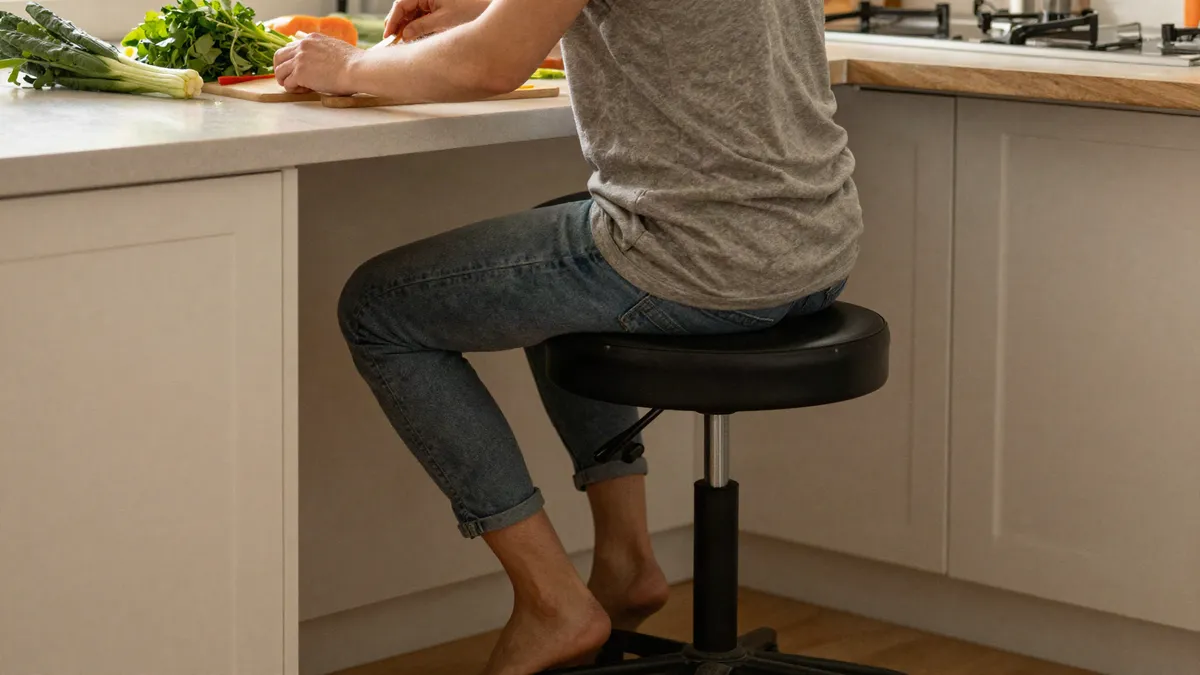
A rolling saddle stool can work as a simple mobility aid at home, letting you sit while you cook, clean, get ready or work at a counter instead of standing.
The saddle seat puts you in a half-standing posture that is tall enough to reach kitchen counters, and the wheels let you scoot between tasks without getting up.
People with foot injuries, joint conditions, chronic fatigue and limited standing tolerance describe these stools as life-changing, but they are not right for everyone, and wheels add a fall risk.
This guide covers who benefits, what to look for, and how to use one safely.
Who Benefits From a Rolling Saddle Stool at Home?
In a widely shared post on r/disability, one user described discovering a rolling saddle stool at the hair salon after a serious foot injury left her barely able to walk around the house.
She now uses it to scoot around the house, sit while cooking and preparing food, and clean, because she cannot stand for long.
Others in the discussion described the same benefits.
- Ambulatory wheelchair users who need support at home but find a wheelchair too big for their rooms.
- People with joint conditions or chronic fatigue who tire quickly when standing.
- People recovering from foot, ankle or leg injuries.
- Anyone who struggles to stand at a sink, vanity or counter, with one user rolling between both sides of a bathroom vanity to get ready with less energy.
- People with hypermobility, some of whom find split saddle seats more comfortable than any office chair.
Saddle Stool vs Perching Stool vs Regular Rolling Stool
| Rolling saddle stool | Perching stool | Flat rolling stool | |
|---|---|---|---|
| Seat shape | Saddle, thighs angled down | Forward-sloping seat, often with arms | Flat round seat |
| Wheels | Yes | Usually no, legs or ferrules | Yes |
| Counter height | Reaches most kitchen counters | Designed for counter work | Often too low for counters |
| Moving between tasks | Easy, you scoot | You have to stand and move it | Easy, you scoot |
| Stability | Good on a wide five-wheel base, but it can roll | Most stable, it does not roll | Similar to a saddle stool |
| Best for | Active tasks around a room | Standing-height tasks in one spot, unsteady users | Lower tasks such as tidying or gardening |
Occupational therapists often recommend a perching stool, a fixed, forward-sloping seat, for kitchen and grooming tasks.
A rolling saddle stool trades some of that stability for the ability to move, so it suits people who can safely control a stool on wheels.
What to Look For
| Feature | What to choose | Why |
|---|---|---|
| Wheels | Rollerblade-style polyurethane wheels | They glide quietly and do not catch or grind like hard office casters |
| Seat height range | A range that covers counter-working height, about 21 to 27 inches (54 to 69 cm) | Too low and you reach up, too high and you perch unsafely |
| Weight capacity | At least 50 lb above your body weight | Gas cylinders fail early when run near their limit |
| Base | Five wheels on a wide base | Wider bases are harder to tip, especially at taller heights |
| Backrest | Optional, but helpful for longer sitting | Gives a rest point between tasks |
| Seat shape | Split seat if a solid saddle causes pressure | Split seats reduce pressure on the sit bones and groin |
The wheel point came up again and again in the r/disability discussion.
“I would avoid casters if you scoot around the house,” one commenter wrote, and others agreed that switching to rollerblade wheels makes a massive difference.
If your stool came with standard casters, you can swap them for rollerblade-style wheels in a few minutes, and our guide to rollerblade wheels for chairs and stools explains how to match the stem size.
Stools That Work Well
- Antlu saddle stool with back support: the model a commenter pointed to in the r/disability discussion and the most-recommended pick across our guides, with a backrest for longer sitting. Check price on Amazon
- Master Massage split saddle stool with backrest: a split seat for people who find a solid saddle presses on the hips or groin. Check price on Amazon
- Rollerblade-style replacement wheels: turn almost any rolling stool into a smoother, quieter scooter. See rollerblade wheels on Amazon
- For gardening, a rolling garden seat with large wheels works better than an indoor stool, because standard casters sink into soil and grass. See rolling garden seats on Amazon
Use our saddle stool sizing guide to match the seat height range to your height and counter.
How to Use a Rolling Stool Safely
NHS occupational therapy guidance on perching stools gives safety rules that apply even more to stools on wheels.
- Push up with both hands or both armrests when standing, never one side only, because one-sided pressure can tip the stool.
- Do not reach down to the floor or lean far over the side, which shifts your weight outside the base.
- Never use a rolling stool in the shower or a wet room, because wet floors and wheels do not mix.
- Sit fully before you scoot, and move slowly near doorways, rugs and floor transitions.
- Avoid rugs and thick carpet where wheels catch, and choose smooth hard floors where possible.
- Lower the seat a little if your feet do not rest firmly on the floor, because firm footing is how you control the stool.
If you have balance problems, dizziness, or a history of falls, ask your physical or occupational therapist whether a fixed perching stool would be safer for you.
Getting Used to a Saddle Seat
A saddle seat feels unusual for the first few days.
Your inner thighs and core do a little more work than on a flat seat, and most people adapt within one to two weeks of gradually longer use.
Our guide on how to sit on a saddle stool walks through the setup and adaptation period.
FAQs
Can a saddle stool be used as a mobility aid?
Yes, for some people. A rolling saddle stool lets you sit at counter height and scoot between tasks, which helps people who cannot stand for long. Check with your physical or occupational therapist first, because wheels add a fall risk.
What wheels are best for scooting around the house?
Rollerblade-style polyurethane wheels are best for scooting. They roll smoothly and quietly on hard floors and do not catch the way standard office chair casters do.
What is a perching stool?
A perching stool is a fixed, forward-sloping seat, often with arms, that lets you sit at counter height for tasks such as cooking or washing up. It does not have wheels, so it is more stable than a rolling stool.
Is a rolling stool safe for elderly people?
It can be for people with good balance and leg control, but wheels add a fall risk. People with balance problems or a history of falls are usually safer on a fixed perching stool, so ask a clinician before buying.
How high should a stool be for kitchen work?
Perching stools for kitchen work are typically adjustable between about 21 and 27 inches (54 to 69 cm), which suits most counters. Your feet should still rest firmly on the floor or a foot ring.
Can I use a rolling stool in the bathroom?
You can use one at a dry bathroom vanity, but never in the shower or a wet room, because wet floors and wheels make slipping much more likely.