TL;DR
- Loupe working distance is the distance from your eyes to the tooth you are treating, measured while you sit in your real working posture.
- Most seated clinicians land somewhere between about 14 and 18 inches (35 to 45 cm), but taller operators often need more.
- Your stool sets that distance, so measure while sitting on the stool you will actually use, whether that is a saddle stool or a flat stool.
- Switching from a flat stool to a saddle stool, or the reverse, can push you out of focus and back into a forward-head posture.
- Set the distance slightly long rather than short, so you are not forced to lean in to stay in focus.
Last updated October 19, 2026. Written from loupe-fitting guidance published in dental hygiene journals and first-hand reports from hygienists and dentists.
Loupe working distance is the distance between your eyes and the working area of the tooth when you sit in your best neutral working posture.
Most seated dentists and hygienists measure somewhere around 14 to 18 inches (35 to 45 cm), but the right number is individual and depends on your height, arm length, and the stool you sit on.
Because your stool height and seat shape decide how tall you sit, the stool and the loupes have to be fitted together.
This guide explains how to measure working distance properly, why changing stools can ruin a good loupe fit, and how to set up both so your neck stays neutral.
What Is Loupe Working Distance?
Working distance is the eye-to-tooth distance at which your loupes are in sharp focus.
It is fixed into the optics when the loupes are made, which is why a measurement taken in the wrong posture locks you into that wrong posture for years.
Two related terms matter as well.
- Depth of field is the range closer and farther than your working distance where the image stays sharp, and it shrinks as magnification goes up.
- Declination angle is how steeply the loupes point downward, and a steeper angle lets you look down at the mouth with your head closer to upright.
How to Measure Your Working Distance
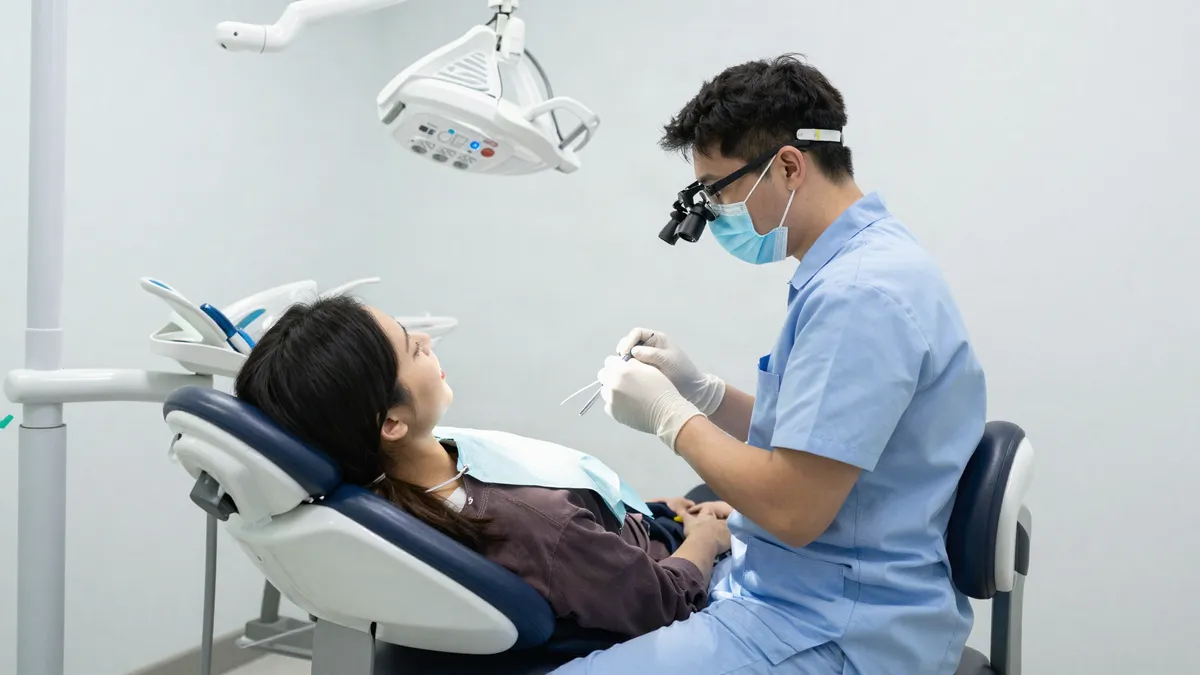
Measure seated, in your real chairside posture, on the stool you will use every day.
Dental hygiene educators recommend having a colleague take the measurement, with the patient’s mouth at about your elbow height.
| Step | What to do | Why it matters |
|---|---|---|
| 1 | Sit on your own stool at your normal working height, with thighs angled slightly down | Seat height sets how tall you sit and therefore your eye height |
| 2 | Sit back with your pelvis tilted slightly forward and your spine in its natural curve | A slouched or over-straight back changes the distance |
| 3 | Set the patient chair so the mouth is at about your elbow height | A patient set too high pushes your shoulders up |
| 4 | Look down at the working area by tilting your head no more than about 20 degrees | More than that strains the neck over a full day |
| 5 | Have a colleague measure from your eye to the tooth with a tape measure | This is your working distance |
| 6 | Repeat at 12, 10 and 8 o’clock (or 12, 2 and 4 for left-handers) | Your distance changes with clock position |
One dental school clinician advises choosing the longer end of your measured range.
If loupes only come into focus when you lean in, you will drift into a hunched posture to see clearly.
Why Your Stool Changes Everything
Your stool decides how tall you sit, how far your pelvis tilts, and how close you can get to the patient, so it directly changes your working distance.
A saddle stool opens the hip angle to roughly 110 to 135 degrees, which tilts the pelvis forward and lifts the torso into a more upright position.
That typically raises your eye height and can lengthen your working distance compared with a flat stool at the same seat height.
Hygienists describe this problem in their own words.
One hygienist on r/DentalHygiene explained that her rep fitted her ergo loupes while she sat on a saddle chair, and that when she sits on a flat chair she ends up too close and out of focus.
Another, who had just bought ergo loupes measured on a flat chair, worried that her saddle chair would no longer match them.
The rule is simple: fit your loupes on the stool you will actually use, and keep using that stool.
If you plan to switch to a saddle stool, make the switch first and get used to it for two weeks, then get measured for loupes.
Our guide on how to sit on a saddle stool covers the adjustment period, and our saddle stool sizing guide shows which height range suits your body.
Saddle Stool vs Flat Stool for Loupe Users
| Saddle stool | Flat stool | |
|---|---|---|
| Hip angle | About 110 to 135 degrees | About 90 to 105 degrees |
| Torso position | More upright, pelvis tilted forward | Tends to round the lower back over time |
| Effect on working distance | Usually raises eye height, so the distance can be longer | Usually shorter, with a tendency to lean in |
| Getting close to the patient | Legs straddle, so you can sit closer | Knees can block close positioning |
| Main trade-off | Needs a two-week adaptation and the right seat width | Easier to start with, but easier to slump |
Neither stool is wrong.
What matters is that your loupes are measured on the stool you use, at the height you use it.
Ergo Loupes, Declination Angle and Your Neck
Ergonomic (prism or “ergo”) loupes bend the line of sight downward so you can look at the mouth while your head stays close to upright.
Many hygienists credit ergo loupes with more pain relief than any stool, and repeated threads on r/DentalHygiene and r/Dentistry put them at the top of the list alongside core strength and a properly adjusted stool.
Even with ergo loupes, the stool still matters, because ergo optics only work if you sit at the height and distance they were built for.
Expect an adjustment period of a few weeks with new ergo loupes, just as with a new saddle stool.
Common Fit Problems and Fixes
| Problem | Likely cause | Fix |
|---|---|---|
| Everything is sharp only when you lean in | Working distance set too short, or the stool is now higher than when you were measured | Lower the stool slightly or get remeasured on your current stool |
| Neck aches by lunchtime | Declination angle too shallow, or the patient chair is too high | Lower the patient chair to about elbow height, and ask about a steeper declination or ergo loupes |
| Blurry at 12 o’clock but fine at 8 o’clock | Distance changes with clock position | Re-measure at several clock positions and choose the longer end |
| Loupes were great until you changed stools | New stool changed your eye height | Return to your old stool height or get re-fitted |
| Shoulders rise during long procedures | Patient too high or stool too low | Keep the mouth at about elbow height |
How We Researched This Guide
We based the measurement steps on loupe-selection guidance published by Dental Economics and Dimensions of Dental Hygiene.
We added first-hand reports from hygienists and dentists in public discussions on r/DentalHygiene and r/Dentistry about how stools and loupes interact.
We do not sell loupes, and this page has no loupe affiliate links.
Read more about how we review dental seating.
FAQs
What is a good working distance for dental loupes?
Most seated clinicians measure about 14 to 18 inches (35 to 45 cm) from eye to tooth, but the right distance is individual. Measure seated in your real working posture, on your own stool, and choose the longer end of your range so you are not forced to lean in.
How do I measure my loupe working distance?
Sit on your usual stool at working height, set the patient so the mouth is at about your elbow height, keep your head tilted no more than about 20 degrees, and have a colleague measure from your eye to the tooth. Repeat at several clock positions.
Should I get loupes measured on a saddle stool?
Yes, if a saddle stool is what you work on. A saddle stool usually raises your eye height compared with a flat stool, so loupes measured on one stool can feel too short or too long on the other.
Can changing my stool affect my loupes?
Yes. A different stool or seat height changes your eye height and posture, which can move you out of the loupes’ focus range and push you into leaning forward. Keep the same stool and height you were measured on.
Do ergo loupes replace a good stool?
No. Ergo loupes reduce how far you tilt your head, but they only work at the distance and height they were built for, so a stable, correctly adjusted stool is still part of the setup.
What happens if my working distance is too short?
You will need to lean toward the patient to keep the image sharp, which rounds your back and pushes your head forward, the posture loupes are supposed to prevent.