TL;DR
- Research does not show that standing is better than sitting for dentists and hygienists, or the other way around.
- What the evidence does support is changing position: dentists who mostly sat reported worse low back pain than those who alternated.
- Standing works best for short procedures, hard-to-reach angles and clinicians whose pain is triggered by sitting.
- A saddle stool is the middle ground, putting your thighs at roughly a 45-degree angle, halfway between sitting and standing.
- If you stand, the delivery system, patient height and a cushioned anti-fatigue mat all need to be set up for it.
Last updated October 19, 2026. Based on published dental ergonomics research and first-hand reports from hygienists and dentists.
Disclosure: some links on this page are affiliate links. If you buy through them we may earn a small commission at no extra cost to you.
Neither standing nor sitting has been shown to be the better working position for dentists and dental hygienists.
The small studies that exist found poor posture in both positions, and the most consistent finding is that clinicians who change position through the day report less low back pain than those who stay seated.
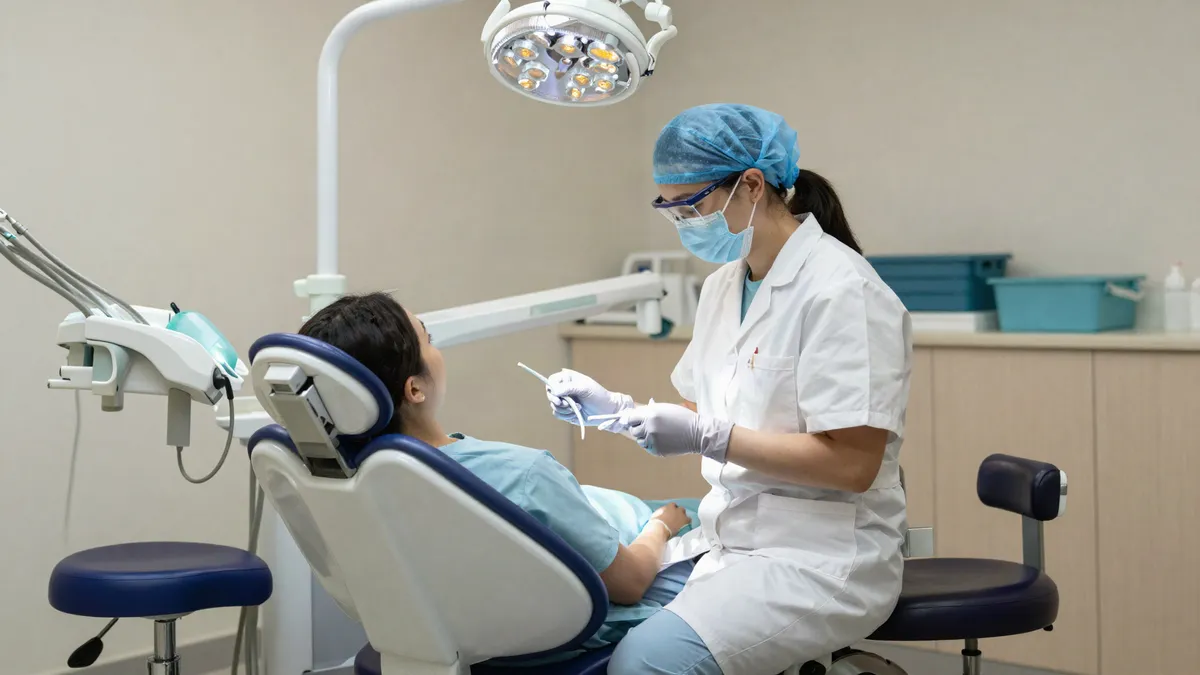
In practice, most clinicians do best sitting for most procedures, standing for some, and using a saddle stool to sit in a posture that is closer to standing.
This guide summarizes what the research shows, what working clinicians report, and how to set up an operatory if you want to stand.
What the Research Says
| Study | Who | Finding |
|---|---|---|
| Musculoskeletal symptoms among dentists in relation to work posture (Work journal) | Practicing dentists | Dentists who sat most of the time reported more severe low back pain than those who alternated between sitting and standing |
| Seated vs standing posture pilot (Journal of Dental Hygiene) | 34 dental hygiene students | Seated posture scored slightly better than standing on the RULA ergonomic tool, but no participant had acceptable posture in either position |
| Alternating seated and standing protocol | 30 dental hygiene students | Switching position every 30 minutes had minimal effect on ergonomic scores or pain |
| Observation study run with a stool manufacturer | 10 dentists, 10 hygienists | Dentists were seated 78 percent of the time and hygienists 66 percent |
The honest summary is that the evidence is thin, mostly from small student groups, and does not prove that standing prevents musculoskeletal problems.
It does point clearly to two things: posture training matters in both positions, and holding any one posture all day is the real risk.
When Standing Works Well
Many working clinicians stand for part or all of the day, and their reports describe consistent benefits.
- Short or simple procedures, such as exams, quick restorations and some hygiene tasks.
- Hard-to-reach angles, where standing at a different clock position gives a direct view without twisting.
- Clinicians whose back or hip pain is triggered by sitting, including some with sciatica or piriformis pain.
- Variety through the day, with one hygienist describing a second operatory she deliberately left without a stool so she stands whenever she works there.
Several hygienists with long careers told r/DentalHygiene that switching to standing, or mixing standing with sitting, did more for their neck and back than any single product.
When Standing Causes Problems
Standing has real downsides, and clinicians who tried it list the same ones.
- The delivery system is built for sitting, so you end up bending to pick up handpieces from a rear or side delivery unit that does not rise far enough.
- Assistants are meant to sit higher than the operator, which is hard to arrange when the operator stands and the assistant is short.
- Leg and foot fatigue build up over long procedures, especially on hard floors.
- Long, detailed procedures are harder to do steadily while standing, and some dentists say quality suffers.
The Middle Ground: A Saddle Stool
A saddle stool puts your thighs at roughly a 45-degree angle, which places you in a posture between sitting and standing.
Your pelvis tilts forward, your lower back keeps its natural curve, and you sit taller and closer to the patient than on a flat stool.
Clinical guidance in dental hygiene publications describes the saddle stool in exactly these terms, as a way to get some benefits of standing while still sitting.
Many clinicians who cannot stand all day use a saddle stool for most procedures and stand for the rest.
Our pick list of the best saddle stools for dental hygienists covers options by body type, and the saddle stool sizing guide helps you choose the right height range.
How to Set Up an Operatory for Standing
| Setting | What to aim for |
|---|---|
| Patient height | Raise the patient chair so the mouth is at about your elbow height while standing |
| Delivery system | Choose or adjust a delivery unit that rises high enough to reach handpieces without bending |
| Floor | Use a cushioned anti-fatigue mat at your main standing position |
| Footwear | Supportive, cushioned shoes, since you are on your feet for long stretches |
| Assistant | Raise the assistant’s stool so their eyes are higher than yours, and use an assistant stool with a torso support |
| Schedule | Alternate between sitting and standing rather than standing all day |
A cushioned mat makes a noticeable difference on hard operatory floors, and one dental assistant described a colleague who stands on a memory-foam mat at her station all day.
See anti-fatigue mats on Amazon
A Practical Plan: Alternate on Purpose
The pattern most supported by both research and clinician experience is to vary your position deliberately.
- Sit, ideally on a saddle stool, for long and detailed procedures.
- Stand for short procedures, exams and hard-to-reach clock positions.
- Take short micro-breaks to stretch between patients.
- Build core and back strength outside work, which dentists and hygienists repeatedly name as the factor that keeps them working pain-free.
- Use ergonomic loupes so your head stays close to upright in either position, and see our guide to loupe working distance to match them to your stool.
For the bigger picture on preventing back and neck pain, read our dental ergonomics guide.
FAQs
Is it better for dentists to stand or sit?
Neither position has been proven better. Studies found poor posture in both, and dentists who alternated between sitting and standing reported less severe low back pain than those who mostly sat. Changing position through the day is the best-supported approach.
Can dental hygienists work standing up?
Yes, and many do for some or all procedures. Standing works best when the patient chair and delivery system are raised to suit you and you use a cushioned anti-fatigue mat.
How often do dentists sit while working?
A small observation study found dentists were seated about 78 percent of the time and hygienists about 66 percent, with the rest spent standing.
Is a saddle stool a good compromise between sitting and standing?
Yes. A saddle stool puts your thighs at roughly 45 degrees, a posture between sitting and standing that keeps the lower back curved while still letting you sit through long procedures.
Does standing reduce neck pain for hygienists?
Some hygienists report less neck and back pain after standing for part of the day, but research has not confirmed a benefit. Ergonomic loupes, correct patient height and core strength have stronger support from clinician experience.