

TL;DR
- A safe clinical chair needs six things: a stated weight rating, soft start/stop, an emergency stop, a stable base with covered mechanisms, manual lowering, and UL/CSA or CE certification.
- Real FDA recalls show where chairs actually fail: pinch points, accessory arms detaching, and magnetic parts near pacemakers.
- If a patient collapses, start CPR in the chair: recline it flat and put a stool under the backrest at shoulder level to stop it flexing.
- A two-minute monthly check of the stop, manual release, cords and covers catches most problems before they hurt someone.
Last updated October 19, 2026, with recall records from the FDA medical device database and current resuscitation research.
A safe clinical dental chair has six things: a stated patient weight capacity, smooth start/stop movement, an emergency stop or movement lockout, a stable base with covered moving parts, a manual lowering option for power failures, and current electrical safety certification (UL/CSA or CE).
Everything else is comfort, not safety.
This guide explains what each feature protects against, what past FDA recalls teach about where chairs fail, and how to handle emergencies such as CPR in the chair.
Disclosure: some links on this page are affiliate links. If you buy through them we may earn a small commission at no extra cost to you.
The Six Essential Safety Features, Explained
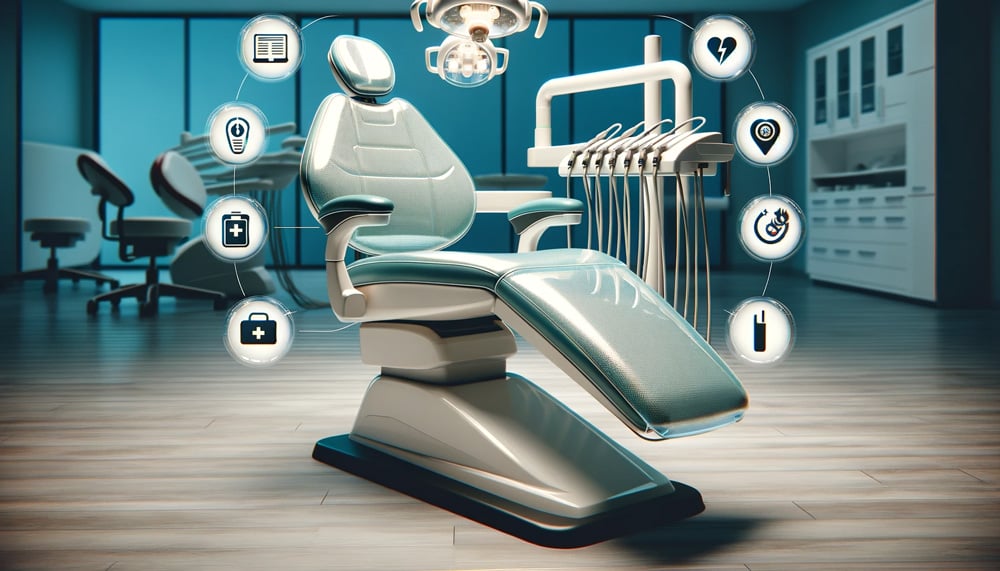
| Feature | What it protects against | What to check |
|---|---|---|
| Rated weight capacity | Lift failure, hinge failure, sudden drops | Serial plate or IFU manual, and see our dental chair weight limits by model |
| Soft start/stop movement | Patient jolts and instrument slips during motion | The chair should never lurch when a control is pressed |
| Emergency stop / movement lockout | Accidental control activation mid-procedure | Motion halts immediately from both the operator and assistant side |
| Stable base with covered mechanisms | Tipping, and pinch injuries to feet, hands and cables | No exposed lift linkages, and base covers refitted after every service |
| Manual lowering / anti-trap release | A patient stuck elevated in a power cut | Every team member knows where the manual release is |
| Electrical certification | Shock and fire risk | UL or CSA mark (North America) or CE (Europe), intact cords and proper grounding |
If you are comparing other clinical chairs, such as mobile procedure, phlebotomy or bariatric chairs, add locking casters and brakes to this list, because those chairs move between rooms.
What FDA Recalls Teach About Chair Safety
Looking at real recalls is the best way to see how dental chairs actually hurt people.
These records are in the FDA’s public medical device recall database.
- Pinch points: A-dec recalled the Decade Plus 1221 chair because the backrest could create a pinch point against the underside of the armrests, and the fix was reprogramming the chair to stop the back before it reached full upright.
- Accessory arms detaching: a recall covering several DCI Equipment, Marus and Pelton & Crane Spirit chairs involved a link arm holding rear-mounted accessories that could break and detach.
- Magnets near implanted devices: a magnetic headrest accessory was recalled because it could affect the programming of some pacemakers and implantable defibrillators.
The lessons are practical.
Keep hands and feet clear of the backrest and armrest as the chair moves, check that accessory arms are tight at every service, and ask patients about pacemakers or defibrillators before placing any magnetic accessory near the chest.
If you own an older chair, search the FDA recall database by brand and model to confirm any recall fix was carried out.
Modern Safety Technology
Newer chairs add sensor-based protection on top of the basics.
Obstruction sensors stop downward travel if something, or someone’s knee, is under the chair.
Position memory moves the patient along tested-safe paths rather than straight lines.
Control lockouts disable chair movement while handpieces are active, and some touch panels have a cleaning lock so wiping them does not trigger movement.
On electric chairs, surge protection matters more than most practices assume, because a voltage spike can damage the control board.
A medical-grade surge protector is cheap insurance.
CPR in the Dental Chair
The European Resuscitation Council recommends starting CPR in the dental chair when a patient has a cardiac arrest during treatment, rather than losing time moving them to the floor.
The problem is that most chair backrests flex under chest compressions, which makes compressions shallower.
A 2022 study from Kyushu University found that placing a stool under the backrest cut backrest movement by about 90 percent on a flat chair.
Placing the stool under the shoulders worked well on chairs of any shape, including strongly curved backrests.
- Recline the chair fully flat and lower it so the rescuer can lock their arms straight over the chest.
- Slide an operator stool under the backrest at shoulder level.
- Start compressions immediately and call for the AED.
Practice this as a team drill, because finding the right stool and height in a real emergency takes longer than people expect.
Safe Patient Positioning: Semi-Supine, Supine and Emergencies
Most routine treatment happens in the semi-supine or supine position, and the safe position changes in a few situations.
- Pregnant patients in later pregnancy: avoid lying them flat on their back for long periods, and tilt them slightly to the left with a small wedge under the right hip, to prevent supine hypotension (a drop in blood pressure as the uterus presses on major vessels).
- A patient who feels faint: stop treatment, recline them supine and raise their legs above heart level.
- Patients with breathing difficulty or reflux: keep them more upright and avoid a fully supine position.
Our dental chair positions guide explains supine, semi-supine and Trendelenburg positions in detail.
Patient Falls, Transfers and Heavier Patients
Many chair injuries happen getting in and out rather than during treatment.
- Lower the chair fully and raise the backrest before the patient gets up, and give them a moment to sit upright, because people can feel dizzy after lying back or after anesthesia.
- Swing armrests out of the way for transfers, especially for older patients and wheelchair users.
- For heavier patients, position the chair before they sit down and check the rated patient load, because an overloaded lift can stall or a hinge can fail.
Safety for Operator and Assistant Stools
The other chairs in a dental office need safety checks too, because a tipping or rolling stool injures staff far more often than a patient chair does.
- Five-caster base: never use a stool with fewer than five casters, and replace cracked or missing casters immediately.
- A rated weight capacity: most saddle stools are rated around 250 to 300 lb, so check the rating for every user.
- A heavier, wider base: hygienists on Reddit note that stools with light bases feel unstable when leaning to one side.
- Careful caster upgrades: larger rollerblade-style casters glide well, but one clinician reported nearly falling off twice after fitting them, so lock the height and test on your floor first.
Our ergonomic seating guide and saddle stool sizing guide cover choosing and setting up a stable stool.
Dental Restraints and Protective Stabilization
Searches for “dental chair restraints” usually refer to protective stabilization, such as a papoose board for young children or patients who cannot stay still safely.
This is not a standard chair feature.
It is a clinical technique used only with informed consent and within professional guidance, such as the American Academy of Pediatric Dentistry’s guideline on protective stabilization.
For general pediatric seating, see our guide to pediatric dental chairs.
Regulatory Standards
In the US, dental patient chairs are FDA-regulated medical devices, and reputable manufacturers test well beyond rated loads.
A-dec, for example, tests the A-dec 500 to four times its stated patient weight limit.
When buying used or imported, certification is the first thing to verify.
A chair with no UL, CSA or CE marking has no independently verified electrical safety, whatever the listing claims.
More on evaluating pre-owned equipment is in our used dental chair inspection checklist.
Keeping a Safe Chair Safe
Safety features degrade silently: emergency stops that are never tested, manual releases nobody can find, and base covers left off after a service visit.
Put a two-minute monthly check on the schedule.
- Test the emergency stop from both sides of the chair.
- Locate and test the manual lowering release.
- Cycle the full range of motion and listen for new noises.
- Inspect cords, grounding, base covers and accessory arm mountings.
- Check upholstery for cracks, which harbor microbes and are an infection-control risk, not just a cosmetic one.
Fold this into your regular dental chair maintenance routine.
And remember the clinician’s side of safety: a stable, properly adjusted stool prevents the slips and strains that no patient-chair feature can, and our ergonomic seating guide covers it.
FAQs
What safety features do clinical chairs have?
Core safety features are a rated patient weight capacity, smooth start/stop movement, an emergency stop or movement lockout, a stable base with covered mechanisms, a manual lowering option for power failures, and electrical safety certification (UL, CSA or CE). Modern chairs add obstruction sensors and control lockouts.
Can you perform CPR in a dental chair?
Yes. The European Resuscitation Council recommends starting CPR in the dental chair rather than moving the patient. Recline the chair fully flat and place a stool under the backrest at shoulder level, which research shows greatly reduces how much the backrest flexes during compressions.
Have dental chairs ever been recalled?
Yes. FDA recall records include an A-dec Decade Plus chair with a backrest pinch point, an accessory link arm on several DCI, Marus and Pelton & Crane chairs that could detach, and a magnetic headrest that could affect pacemakers.
Are dental chairs FDA regulated?
Yes. In the United States dental patient chairs are regulated as medical devices by the FDA, and manufacturers apply independent electrical safety certification such as UL or CSA on top.
What position is safest for a pregnant patient in a dental chair?
In later pregnancy, avoid lying the patient flat for long periods and tilt her slightly to the left with a small wedge under the right hip. This prevents supine hypotension, a drop in blood pressure caused by the uterus pressing on major blood vessels.
What are dental chair restraints?
The term usually refers to protective stabilization, such as a papoose board for young children or patients who cannot stay still safely. It is a clinical technique used with informed consent, not a built-in chair feature.
What happens if a dental chair loses power with a patient elevated?
Certified chairs include a manual lowering mechanism so the patient can be brought down safely without power. Staff should know where the release is before an outage happens.
What safety features should a dental stool have?
A dental stool should have a five-caster base, a weight rating that suits the user, a stable base that does not tip when you lean, and a reliable height lock. Replace cracked or missing casters immediately.
How often should dental chair safety features be checked?
A quick monthly check is a sensible minimum: test the emergency stop and manual release, cycle the full range of motion, and inspect cords, grounding and base covers. Annual professional servicing should verify the lift system.