
TL;DR
- Ergo loupes use a prism to bend your line of sight downward, so you can see the mouth with your head close to upright.
- They are also sold as ergonomic loupes, deflection loupes and refractive loupes.
- Loupes target the neck and shoulders, and a saddle stool targets the lower back and hips, which is why many clinicians use both.
- Published research supports loupes and saddle seats in general, but ergo loupes themselves have little research behind them yet.
- Buy and adapt to the stool first, then get measured for loupes on that stool.
Ergo loupes are magnifying loupes with a prism in each eyepiece that turns your view downward, so you look straight ahead and still see the patient’s mouth.
Dentists and hygienists who post about neck and back pain mention the same pair of fixes again and again: ergo loupes and a saddle stool.
This guide explains what ergo loupes do, what the evidence says, and how to set them up together with your stool.
We do not review or sell loupes, because they are fitted to you by a rep.
Last updated November 17, 2026, using Amazon listing specifications, published research and public Reddit discussions.
Disclosure: this page contains affiliate links. If you buy through them we may earn a small commission at no extra cost to you. This never affects which products we list.
What Are Ergo Loupes?
Ergo loupes, short for ergonomic loupes, move the downward viewing angle out of your neck and into the optics.
With standard through-the-lens loupes you tilt your head down to aim the lenses at the mouth.
How steeply the lenses point down is called the declination angle, and a shallow angle means more head tilt.
Ergo loupes use a prism to deflect the view, so the image of the mouth reaches your eyes while your head stays close to upright.
You will also see them called deflection loupes or refractive loupes.
The term prismatic loupes is used less carefully, because some prismatic loupes are high-magnification loupes with no deflected view, so read the description before you assume.
Ergo Loupes vs Traditional Loupes
The main difference is where the downward angle comes from: the prism in ergo loupes, or your neck with traditional loupes.
| Ergo loupes | Traditional loupes | |
|---|---|---|
| Head position | Close to upright | Tilted down, by an amount that depends on the declination angle |
| Source of the downward view | A prism in each eyepiece | Head tilt plus the angle of the lenses |
| Weight | Generally heavier | Generally lighter |
| Price | Generally higher | Generally lower |
| Getting used to them | A few weeks | Usually quicker |
Weight and price vary by brand and magnification, so ask the rep for the figures on the exact model you try.
Do Ergo Loupes Help Neck Pain? What the Research Says
Loupes in general are linked with less upper-body pain, but ergo loupes specifically have little published research behind them yet.
A 2018 systematic review of saddle seats and loupes covered eight studies and found that loupes appear to relieve shoulder, arm and hand pain.
The same review found that evidence for an effect on neck pain was scarce.
A 2022 laboratory study of dental students found that standard Galilean loupes improved working posture and neck angle.
We did not find a published trial that compares ergo loupes with standard loupes for neck pain.
The case for them rests on mechanics and on what clinicians report.
In an r/Dentistry thread on ergonomics, one dentist said a loupe with a built-in prism made the biggest difference of anything they tried.
The reports are not all positive: in an r/DentalHygiene thread about neck pain, one hygienist said the neck pain stayed chronic despite ergo loupes and physiotherapy.
Why Clinicians Pair Ergo Loupes with a Saddle Stool
Clinicians pair them because each one corrects a different part of the same posture.
Loupes decide what your head and neck do, and the stool decides what your pelvis and lower back do.
Fix only the stool and you may still crane your neck to see, and fix only the loupes and you may still slump from the hips.
The 2018 review reached a similar view, noting that the two measures may have an additive effect when used together.
One reply in the r/Dentistry thread listed just three things: ergo loupes, a saddle stool and stretching every night.
A hygienist with 11 years in practice named both in the r/DentalHygiene thread, alongside strength training and a four-day week.
| Problem | What loupes do | What a saddle stool does |
|---|---|---|
| Head tilted forward | Ergo loupes let you see with the head close to upright | Little direct effect |
| Leaning in to see detail | Magnification lets you sit back | Legs straddle the seat, so you can sit closer without leaning |
| Rounded lower back | Little direct effect | Open hip angle helps the lower back keep its curve |
| Raised shoulders | Correct working distance keeps arms relaxed | Correct height puts the mouth at elbow level |
Setting Up the Pair: Working Distance, Seat Height, Patient Height
Set up the stool first and the loupes second, because your seat decides your eye height.
- Choose your stool and use it for about two weeks, until the saddle position feels normal.
- Set the seat so your hips are clearly above your knees with both feet flat.
- Set the patient chair so the mouth is at about your elbow height.
- Get measured for loupes while sitting on that stool at that height.
- Ask for the measurement at several clock positions, and choose the longer end of your range.
- If you change stools later, check that your loupes still focus without leaning in.
Our guide to loupes working distance has the full measuring method.
For the stool, see how to sit on a saddle stool and the height and sizing guide.
What Equipment Cannot Fix: Strength, Movement, Schedule
Equipment improves your position, but it does not make your body able to hold that position all day.
A blunt reply in an r/CanadianDentists thread on operator stools said the chair is not the problem and told the poster to stay in shape.
Others in the same thread recommended a dental ergonomics course and a physiotherapist.
Several clinicians in these threads also work standing for part of the day, move the patient instead of themselves and stretch between appointments.
Some reduced their clinical days, which is a reminder that hours in the chair matter as much as the chair.
Our dental ergonomics guide covers posture, positioning and breaks in one place.
Saddle Stools That Suit Loupe Users
For loupe users, the most useful feature in a stool is a height range that puts you at the same working height every day.
Antlu Saddle Stool with Back Support: Best Overall
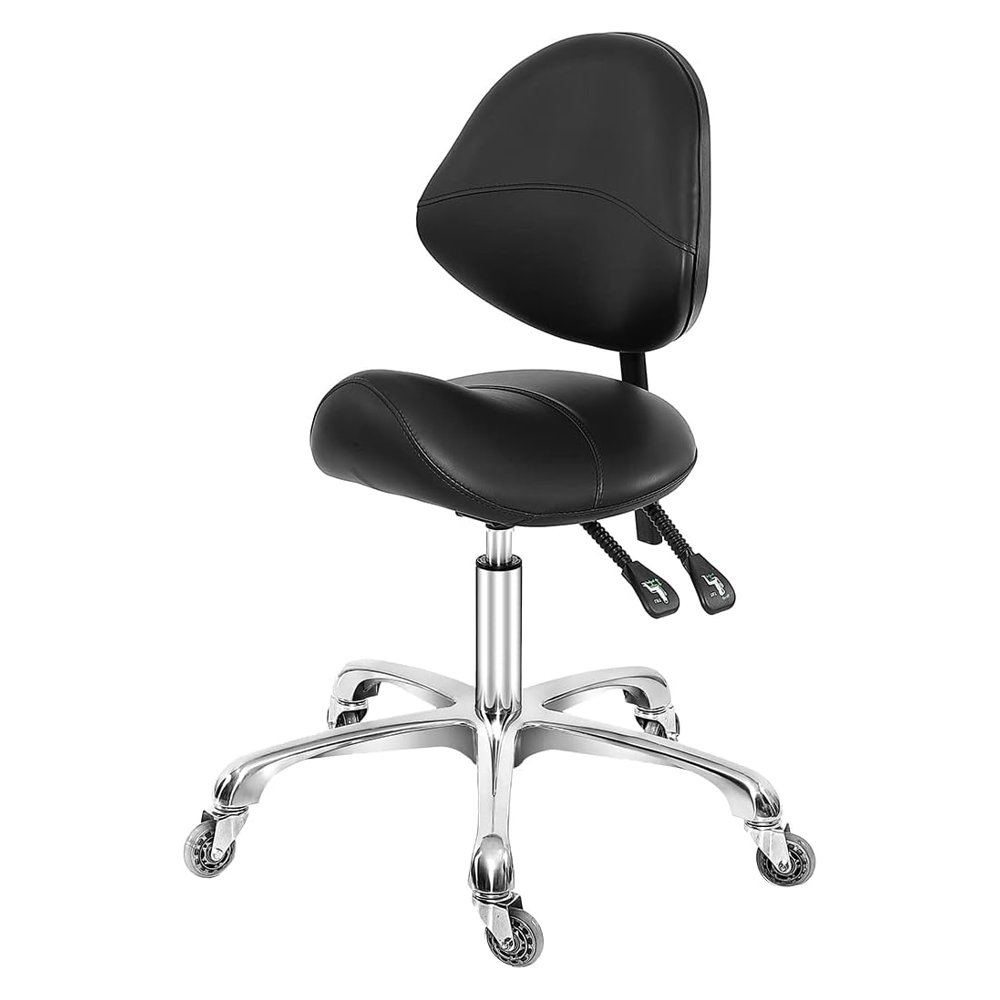
Choose this one if you want a saddle seat with a backrest for the pauses between patients.
The seat adjusts from 20 to 28 inches and the backrest is adjustable.
It is rated to 300 lb.
HNKastela Saddle Stool with Foot Ring: Best for Shorter Clinicians
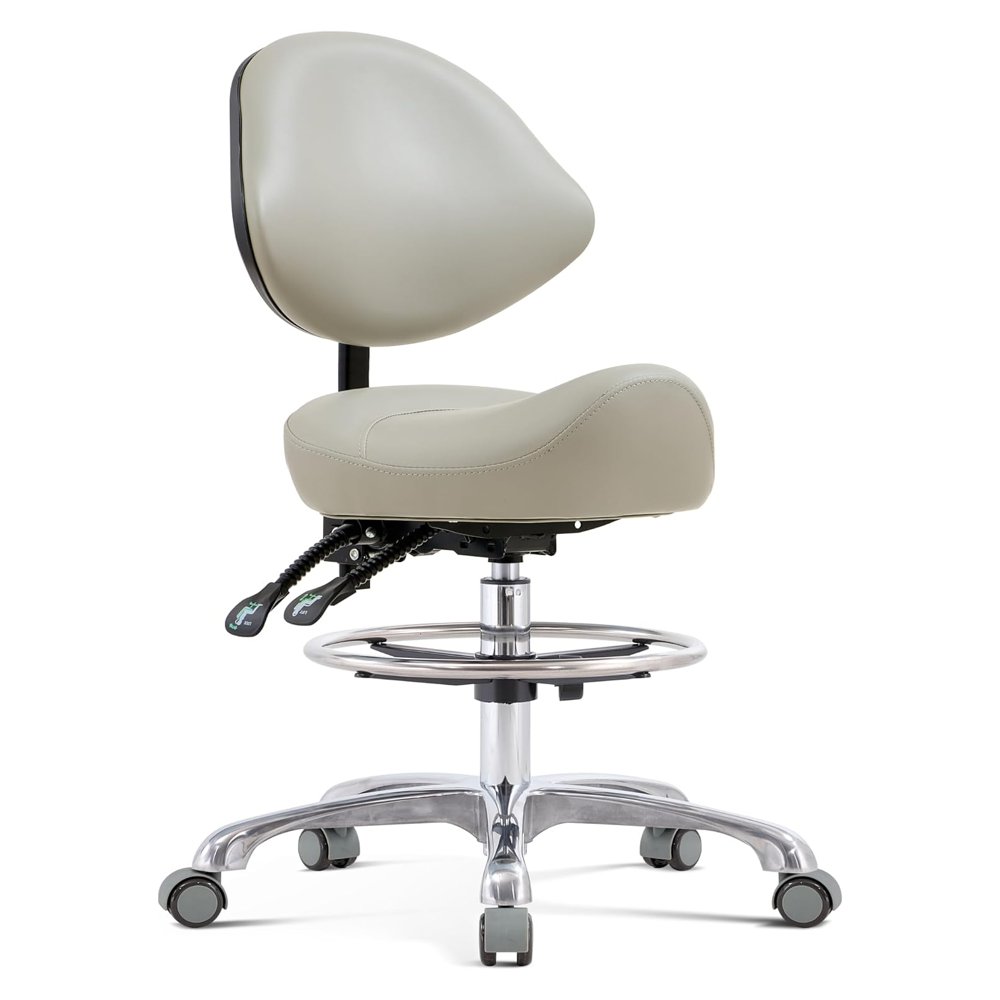
Choose this one if most stools leave your feet hanging at working height.
The seat starts at 19 inches, the lowest verified minimum among our budget picks, and goes up to 28 inches.
It has a backrest and a foot ring and is rated to 400 lb.
FRNIAMC Backless Saddle Stool: Best for Taller Clinicians
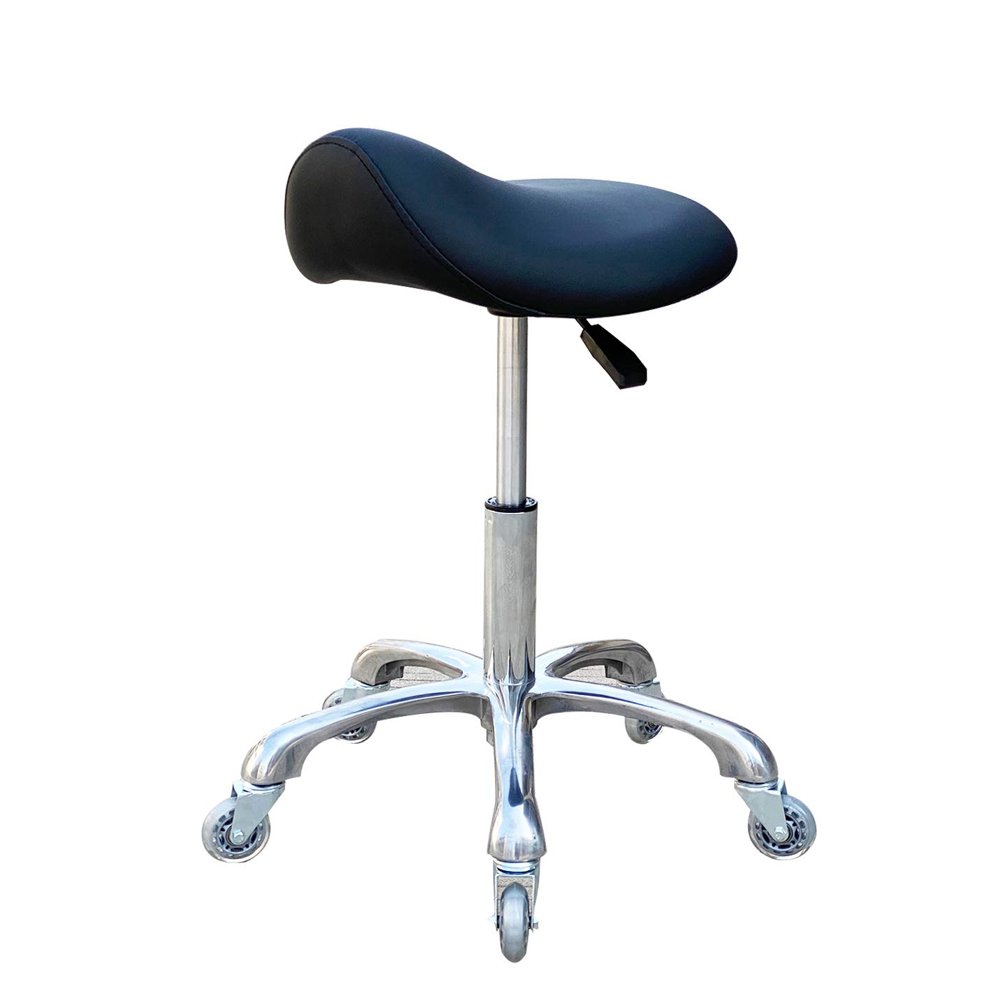
Choose this one if you need extra height or move around the patient constantly.
The seat adjusts from 20 to 29.5 inches.
The listing gives 400 lb and 450 lb in different places, and we publish 400 lb.
More picks are in our guides to the best saddle stools for dental hygienists and the best dental stools.
If price is the question, see Amazon saddle stools vs $1,000 dental brands.
FAQs
What are ergo loupes?
Ergo loupes are dental loupes with a prism in each eyepiece that deflects your view downward. You look straight ahead with your head close to upright and still see the mouth. They are also called ergonomic, deflection or refractive loupes.
Are ergo loupes worth it?
Many dentists and hygienists on Reddit say they made the biggest difference to their neck, and some report little change. Published research supports loupes in general, but there is little research on ergo loupes specifically, so try a demo pair before you commit.
Do ergo loupes help neck pain?
They are designed to, because they let you work with your head close to upright. A 2018 systematic review found loupes appear to relieve shoulder, arm and hand pain, with little evidence on neck pain, and we did not find a trial of ergo loupes specifically.
Should I get a saddle stool or ergo loupes first?
Get the stool first. Your seat sets your eye height, and loupes are built for one working distance, so adapt to the stool for about two weeks and then get measured for loupes on it.
What is the difference between ergo loupes and regular loupes?
Regular loupes need you to tilt your head down to aim them at the mouth. Ergo loupes use a prism to bend the view, so most of that angle comes from the optics. Ergo loupes are generally heavier and cost more.